
Clean green loads
Yard Waste Dumpster Rental Battle Creek MI
Michigan has banned yard clippings from landfill disposal for decades, and that single rule shapes this entire service. Green material has to be composted or processed, which means it cannot ride along in a general container with the old fence panels and the broken patio furniture. A yard waste container is a clean green load and nothing else. Here is how to keep it that way.
- Licensed & insured
- Same-day delivery
- Flat-rate pricing
- Locally owned
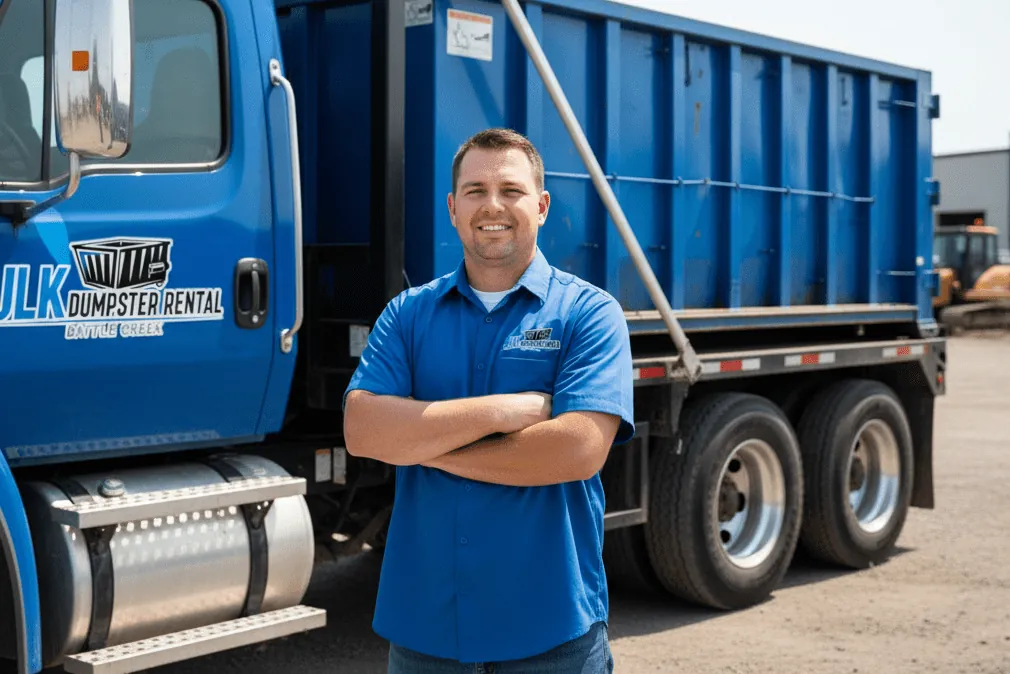
Yard Waste Dumpster Rental Battle Creek MI across Battle Creek and Calhoun County
Michigan law prohibits yard clippings from being disposed of in a landfill or burned in a municipal incinerator. Leaves, grass, brush and garden trimmings are required to be composted or otherwise processed instead, and there is a narrow exception for diseased or infested material where composting would spread the problem. Michigan's solid waste programme is administered by EGLE, and the practical collection arrangements below that differ from municipality to municipality across Calhoun County.
The consequence at your house is simple. Green material travels separately. If we put a container down for brush and it comes back with a length of treated fence rail, two plastic pots and a bag of household trash on top, it is no longer a yard waste load, and the whole economic advantage of running it as a clean load disappears. This is the one service where what you keep out matters as much as what you put in.
What belongs in a green load, and what does not
- In: leaves, grass clippings, brush, branches, hedge and shrub trimmings, garden clearance
- In: storm blowdown, deadwood, prunings and general growing-season cuttings
- Out: pressure-treated fence lumber, decking, posts and anything with a nail in it
- Out: plastic pots, trays, landscape fabric, edging and the bags themselves
- Out: soil, sod, stone and root balls full of dirt, which belong in a heavy container
- Out: household trash of any kind, however convenient the container looks
The bags are the one that catches people every year. Paper yard bags are generally fine; plastic sacks are not, because they contaminate the compost stream and someone has to open every one of them. Tip the contents in and keep the plastic out. If you are also clearing a shed or a garage at the same time, that is a separate container and it is cheaper to run two clean loads than one mixed one.
Brush is mostly air
The most common sizing mistake on yard work is treating a brush pile like a solid volume. It is not. A pile of limbs thrown in whole is perhaps a third material and two-thirds air, and it will spring back over the rails as you go. Cut everything down to manageable lengths, four feet or so where you can, and stack in layers with the cut ends facing the same way. You will fit roughly twice as much in the same box and nothing will be sticking over the top rail when the truck arrives.
Trunk sections are fine within reason, but rounds get heavy fast and a large one can account for a meaningful share of the tonnage allowance by itself. Stumps are a call-first item without exception, because the soil and stone caught in a root ball makes them dramatically denser than the brush around them; a single large stump can be most of a load. Grinding on site is frequently the cheaper route, and if a stump does need hauling it usually belongs in a heavy debris container rather than a green one.
Two seasons, and the storms in between
This work has a shape you can set a calendar by. Spring is the clearance of everything winter broke, plus the first hard cut-back of the year, and it collides awkwardly with the thaw window when seasonal weight restrictions posted by county and local road authorities constrain what a loaded truck can do on some routes. Autumn is leaves and pre-winter tree work, and it is the busier of the two, because every property owner in the county wants deadwood down before the first ice storm.
Between them sit the summer squall lines that come through southwest Michigan and put limbs across half a neighbourhood in twenty minutes. Storm debris arrives mixed, and that is where the ban bites hardest: a tree that took a fence and part of a garage roof with it has produced green waste, treated lumber, shingle and metal simultaneously, and those are four different destinations. Sort as you drag rather than afterwards. If the roof took damage too, that tear-off is its own container entirely.
Booking and placement
Green loads are light, so placement is usually the easy part: a container on the drive near the work, boards under the rails as standard, and a swing door open so you can walk brush in rather than lifting it over a wall. On larger rural properties out in the county, we can often set the box closer to the treeline if the ground is firm, which saves an enormous amount of dragging.
Pricing is flat-rate with a stated tonnage allowance quoted before delivery, and same-day delivery is available on most orders placed before noon, which matters in the days after a storm. Tell us what the pile actually contains when you call (269) 924-0171, including anything you are unsure about, and we will tell you whether it is one clean load or two. There is more on rental periods and swaps on the FAQ page.
Which size suits the job
A hedge cut-back, a season of prunings or a modest garden clearance fits a 10 or 15 yard comfortably. Storm cleanup at a single household, with limbs down and a yard full of debris, usually wants a 20 yard, because brush is mostly air and fills a container far faster than its weight suggests. Tree removal, a large rural lot or a full property clearance justifies a 30 yard, and occasionally a 40 where there is genuine acreage and room to set it. Cutting everything to about four feet and stacking in layers rather than throwing branches in whole will roughly double what any of these hold.
- Clean green loads only, because Michigan bans yard clippings from landfill
- Sized for brush, which is mostly air and fills a box faster than it weighs
- Cut-and-stack advice that roughly doubles what fits in the same container
- Same-day delivery on most pre-noon orders, which counts after a storm
- Stumps and root balls flagged before they eat your whole tonnage allowance
- Straight guidance on what turns a clean load into a mixed one
Sizes
Which container for yard waste & storm debris?
Every service runs in all four sizes. Match the material to the weight allowance and the rest takes care of itself.
| Size | Dimensions | Capacity | Weight included | Best for |
|---|---|---|---|---|
| 10 Yard Dumpster | 12 ft long × 8 ft wide × 3.5 ft high | about 3 pickup truck loads | 1–2 tons | Small bathroom remodels, single-room cleanouts, concrete and heavy debris, roofing up to about 15 squares. |
| 15 Yard Dumpster | 16 ft long × 8 ft wide × 4 ft high | about 4–5 pickup truck loads | 2–3 tons | Basement and attic cleanouts, kitchen remodels, medium roof tear-offs, small deck removals. |
| 20 Yard Dumpster | 22 ft long × 7.5 ft wide × 4.5 ft high | about 6 pickup truck loads | 3–4 tons | Whole-home decluttering, flooring and siding jobs, large tear-offs, drywall and mud phases. |
| 30 Yard Dumpster | 22 ft long × 8 ft wide × 6 ft high | about 9 pickup truck loads | 4–5 tons | Full-house renovations, new construction, estate clearances, commercial fit-outs and demolition. |
| 40 Yard Dumpster | 22 ft long × 8 ft wide × 8 ft high | about 12 pickup truck loads | 5–6 tons | Large commercial fit-outs, industrial clear-outs, major renovations and high-volume light debris. |
Talk to a real person
Need yard waste & storm debris in Battle Creek?
Call (269) 924-0171 and describe the job. You will get a flat price and a delivery time on the same call — most orders before noon go out the same day.
Mon–Sat 7:00am – 6:00pm · Sun by appointment
Answers
Yard Waste & Storm Debris — your questions
Why can yard waste not go in a regular dumpster?
Michigan prohibits yard clippings from landfill disposal and from municipal incineration, with a narrow exception for diseased or infested material. Green waste has to be composted or processed instead, so it cannot travel mixed in with household or construction debris. Running it as a separate clean load is simpler and cheaper than having a mixed load rejected or sorted.
What exactly counts as yard waste?
Leaves, grass clippings, brush, branches, hedge and shrub trimmings, garden clearance and storm blowdown. What does not count is anything manufactured or processed: treated fence lumber, decking, plastic pots, landscape fabric, plastic sacks and household trash. Soil and stone in a root ball are also out, because they belong in a heavy debris container instead.
Can I put a tree stump in it?
Call us before you do. Stumps carry soil and stone in the root ball, which makes them dramatically denser than the brush around them, and one large stump can account for most of a container's weight allowance on its own. Small stumps are usually fine. Large ones often belong in a heavy debris container, or are cheaper ground on site than hauled.
What size do I need for storm cleanup?
For a household with limbs down and a yard full of debris, a 20 yard is the usual answer, because brush is mostly air. Cutting everything to roughly four feet and stacking in layers rather than throwing branches in whole will roughly double what fits. A whole tree down needs a conversation about how many pulls it takes rather than a single guess.
Can I leave the clippings in plastic bags?
No. Plastic sacks contaminate the compost stream and someone has to open every one of them, so tip the contents into the container and keep the plastic out. Paper yard bags are generally fine. The same principle applies to plastic pots, trays and landscape fabric, all of which turn a clean green load into a mixed one.
Service area
Yard Waste & Storm Debris across southwest Michigan
We run roll-off dumpsters out of our 79 Grand Trunk Ave yard across Calhoun County and Kalamazoo County — from the older streets of Urbandale, Springfield and Post Addition out to Pennfield and Bedford, east on I-94 to Marshall and Albion, and west toward Galesburg, Portage and Kalamazoo. If your town is not on this list, call us anyway. We probably still get there.