
Heavy-duty containers
Demolition Debris Dumpster Rental Battle Creek MI
Gut a room in a 1970s ranch and you get drywall. Gut the same room in a Battle Creek house built a century earlier and you get plaster over wood lath, real dimensional lumber behind it and a wall cavity full of a hundred years of settled debris. The two jobs look identical on a schedule and behave nothing alike in a container. This page is about the difference.
- Licensed & insured
- Same-day delivery
- Flat-rate pricing
- Locally owned
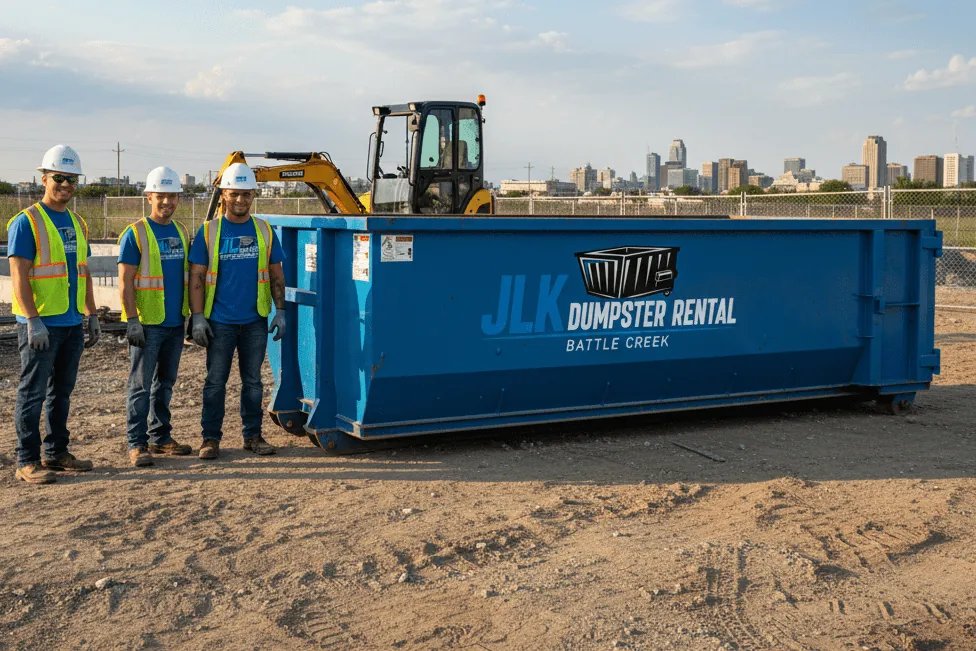
Demolition Debris Dumpster Rental Battle Creek MI across Battle Creek and Calhoun County
Three-coat plaster keyed into wood lath is a genuinely dense wall assembly. Once you count the plaster, the lath and the keys squeezed through behind it, a stripped room produces multiples of what the same room in modern drywall would weigh, and ceilings are usually the heaviest surface of the lot. A single moderate bedroom taken back to the studs can produce well over a ton on its own. Add a plaster ceiling and it climbs from there.
Behind that plaster, in the older Battle Creek stock, sits framing lumber that was cut to its nominal size and has spent a century drying into something noticeably heavier and denser than anything sold at a lumberyard today. That is why demolition containers get sized by weight and by a fill line rather than by room count. A box that looks half empty may already be at its allowance, and there is no way to fix that once the truck has it on the scale.
Assess before you swing anything
Most of the housing stock in this area predates 1980, and a considerable share of it predates 1930. Two things follow from that and neither is optional.
Assume the possibility of asbestos in pipe and boiler insulation, boiler jacketing, resilient floor tile and the mastic underneath it, some older joint compounds, and certain siding and roofing products. Have the building assessed by a qualified inspector before demolition begins rather than discovering it mid-strip; the EPA's asbestos pages explain where it typically occurs and what regulated work involves. Assume lead paint on original trim, windows, doors and stair rails in anything built before 1978, where the hazard is the dust you create rather than the debris itself.
Neither material goes in one of our containers. Regulated asbestos and lead waste follow their own licensed routes with properly certified contractors, and that work has to be completed before general demolition debris starts moving. Sequencing it the other way round is how a two-week project becomes a two-month one.
Fill lines, and loading a heavy box properly
- Take the mid-size container and fill it to a line, not the big one you will never fill
- Load flat and even; plaster heaped at the door end makes a box unsafe to winch
- Damp the material down as you strip, because century-old plaster dust travels everywhere
- Pull nails and screws out of lath bundles if you are stacking rather than throwing
- Keep masonry entirely out of the general demolition load
- Call the swap at three-quarters full rather than at the top rail
The last one matters more on demolition than on anything else, because the visual cue that a container is full arrives long after the weight cue does. If you are unsure whether the box has reached its allowance, call and describe what went in it. A 20 yard is the size most interior gut jobs settle on, filled to a marked line.
Separating the streams on a tight site
Interior demolition produces almost every material category at once: plaster, lath, framing lumber, cast iron waste pipe, old radiators, ductwork, tile, cabinetry, flooring and whatever was in the wall cavities. Cast iron and steel radiators in these houses are heavy enough to eat a meaningful share of a tonnage allowance by themselves, and they have scrap value, so pulling them out carefully instead of smashing them into the box is usually worth the extra half hour.
Masonry belongs in its own container without exception. A chimney breast, a brick hearth, an old foundation wall or a concrete stoop needs the dedicated heavy box described on the concrete and heavy debris page, because mixing it into a general load is how a manageable job becomes an overweight one. Where the demolition is the first phase of a wider build, the containers for the rebuild are a separate conversation and are covered on the construction page.
Access, exteriors and Michigan timing
Interior demolition on older residential lots usually means one placement on a narrow drive, and often a long carry to the container. Set it as close to the exit you are actually using, and expect to run wheeled bins or a barrow rather than carrying by hand; plaster is dense enough that hand-carrying becomes a safety issue by the second hour.
Exterior demolition, garages, decks, porches, outbuildings, adds two constraints. Anything involving excavation or ground disturbance requires utility locates first under Michigan law, which takes days rather than hours. And in the spring thaw window, roughly March through May, seasonal weight restrictions posted by county and local road authorities limit what a loaded truck can haul on some routes in Calhoun County. Both are easy to plan around and expensive to discover late. Call (269) 924-0171 with the age of the building, the rooms involved and what the walls are actually made of, and we will size it properly on the first call.
Which size suits the job
Interior demolition is a weight job, so the answer is usually smaller than the job feels. One or two rooms of plaster and lath fits a 15 yard filled to a line. A full-floor gut, or a kitchen and bathroom taken back to the studs together, sits best on a 20 yard, again filled to a marked line rather than to the top rail. Reach for a 30 yard only when the debris is genuinely bulky rather than dense, such as cabinetry, panelling, decking and light interior framing. Keep chimney brick, concrete and old foundation material in a separate 10 yard, where it belongs.
- Sized by weight and fill line, because old plaster fills allowance before volume
- Straight advice on pre-1980 asbestos and pre-1978 lead paint sequencing
- Masonry kept in its own container instead of wrecking a general load
- Swap called at three-quarters full so nothing leaves the site overweight
- Placement planned around the carry route, not just the driveway
- Flat rate with the tonnage allowance stated before the box arrives
Sizes
Which container for demolition debris dumpsters?
Every service runs in all four sizes. Match the material to the weight allowance and the rest takes care of itself.
| Size | Dimensions | Capacity | Weight included | Best for |
|---|---|---|---|---|
| 10 Yard Dumpster | 12 ft long × 8 ft wide × 3.5 ft high | about 3 pickup truck loads | 1–2 tons | Small bathroom remodels, single-room cleanouts, concrete and heavy debris, roofing up to about 15 squares. |
| 15 Yard Dumpster | 16 ft long × 8 ft wide × 4 ft high | about 4–5 pickup truck loads | 2–3 tons | Basement and attic cleanouts, kitchen remodels, medium roof tear-offs, small deck removals. |
| 20 Yard Dumpster | 22 ft long × 7.5 ft wide × 4.5 ft high | about 6 pickup truck loads | 3–4 tons | Whole-home decluttering, flooring and siding jobs, large tear-offs, drywall and mud phases. |
| 30 Yard Dumpster | 22 ft long × 8 ft wide × 6 ft high | about 9 pickup truck loads | 4–5 tons | Full-house renovations, new construction, estate clearances, commercial fit-outs and demolition. |
| 40 Yard Dumpster | 22 ft long × 8 ft wide × 8 ft high | about 12 pickup truck loads | 5–6 tons | Large commercial fit-outs, industrial clear-outs, major renovations and high-volume light debris. |
Talk to a real person
Need demolition debris dumpsters in Battle Creek?
Call (269) 924-0171 and describe the job. You will get a flat price and a delivery time on the same call — most orders before noon go out the same day.
Mon–Sat 7:00am – 6:00pm · Sun by appointment
Answers
Demolition Debris Dumpsters — your questions
What size do I need to gut a room?
For one room of plaster and lath in an older Battle Creek house, a 15 or 20 yard filled to a line rather than to the top. Plaster is dense enough that a container looking half empty may already be at its tonnage allowance, particularly once ceilings come down. Drywall from a newer building is far lighter and behaves differently, so tell us the age of the house.
Is plaster really that much heavier than drywall?
Considerably, yes. Three-coat plaster keyed into wood lath includes the plaster, the lath and the keys squeezed through behind it, and ceilings are heavier still. A single bedroom stripped to the studs can produce well over a ton. That is why demolition containers get sized by weight and a fill line rather than by counting rooms.
What about asbestos and lead paint in an old house?
Assume both are possible in anything built before 1980 and have the building assessed by a qualified inspector before demolition begins. Asbestos turns up in pipe lagging, boiler jacketing, floor tile and mastic; lead paint is on most original trim and windows in pre-1978 homes. Neither can go in our containers. Regulated material follows its own licensed route with a certified contractor.
Can I put the chimney brick in with the rest of the debris?
Please do not. Masonry is dense enough to blow through a tonnage allowance on its own and it turns an otherwise manageable load into an overweight one. Brick, block, concrete and old foundation material belong in a dedicated heavy container with a marked fill line. Clean masonry is also the cheapest heavy load there is, which is a good reason to keep it clean.
Do I need utility locates before exterior demolition?
If any part of the work disturbs the ground, yes. Michigan law requires notification before excavation, and locate tickets take days rather than hours. That applies to taking out a garage slab, a deck footing, a porch or a stoop, not just to new digging. Factor it into the same schedule as the container delivery so neither one holds the other up.
Service area
Demolition Debris Dumpsters across southwest Michigan
We run roll-off dumpsters out of our 79 Grand Trunk Ave yard across Calhoun County and Kalamazoo County — from the older streets of Urbandale, Springfield and Post Addition out to Pennfield and Bedford, east on I-94 to Marshall and Albion, and west toward Galesburg, Portage and Kalamazoo. If your town is not on this list, call us anyway. We probably still get there.