
Every size we run
Roll-Off Dumpster Rental Battle Creek MI
This is the plain explainer. What a roll-off actually is, how the truck puts one down and picks it back up, what your site has to give it, what each of the five sizes is genuinely for, and how flat-rate pricing with a stated tonnage allowance works. If you have never rented a container before, start here and then call (269) 924-0171.
- Licensed & insured
- Same-day delivery
- Flat-rate pricing
- Locally owned
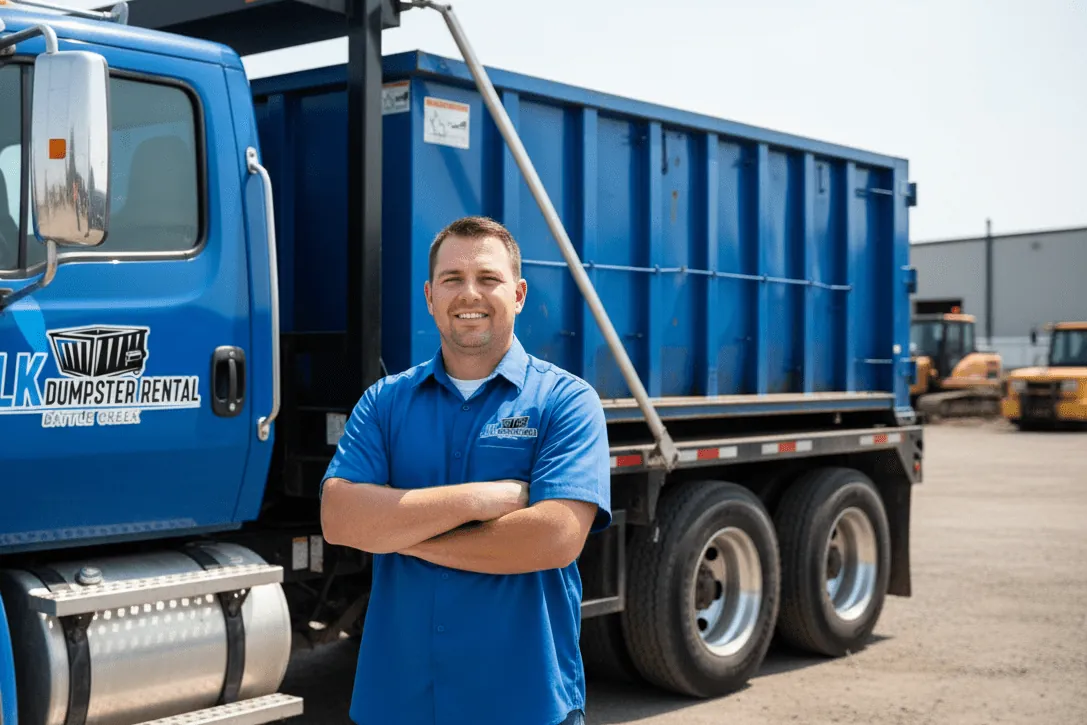
Roll-Off Dumpster Rental Battle Creek MI across Battle Creek and Calhoun County
A roll-off is an open-top steel container with rails welded along its base and small wheels at the back. The truck carries a tilting bed and a cable winch. To deliver, the driver lines the truck up, raises the bed, and lets the container roll off the back until it settles on those rails. To collect, the cable hooks the front of the box and drags it back up the tilted bed. There is no compaction, no crew and no hourly clock; you get the container for the rental period and fill it at whatever pace suits.
That mechanism explains almost every access constraint you will run into, and it explains why the constraint is nearly always length rather than width. The truck cannot swing a container sideways into a gap. It has to line up square, back it down and pull it out the same way.
What your site has to give the truck
- Roughly sixty feet of straight approach in line with where the box will sit
- About twenty-three feet of overhead clearance, because the bed tilts high during the drop
- A firm, reasonably level surface that a loaded container will not sink into
- Vehicles moved and the path clear before the truck arrives, not while it is waiting
- Enough room to open the swing door at the back if you plan to walk material in
- Somewhere the container can sit for the whole rental, since it does not move once it is down
On older Battle Creek streets, overhead clearance stops more deliveries than driveway width does. Mature trees, low service drops and porch overhangs are the usual culprits. If you are not sure, take a photo of the spot from the street and send it, and we will tell you before a truck is loaded rather than after.
Five sizes, and what each one is really for
Yardage measures cubic volume, not weight. The mistake almost everyone makes is choosing on volume when their material is dense, or choosing small because the job feels small. Match the box to the material.
The 10 yard is the heavy box: concrete, brick, block, dirt, tile, a small bathroom strip-out. Low walls, short footprint, and it reaches a legal payload before it runs out of room. The 15 yard suits a basement, a garage or a modest roof. The 20 yard is the workhorse for whole-house cleanouts and most remodels. The 30 yard is for light bulky material, framing offcuts, furniture, commercial clearances. The 40 yard is the largest we run and it only makes sense for genuinely light, high-volume debris; it is never the right answer for rubble. Dimensions for all five sit on the sizes page.
Boards under the rails, every time
A loaded roll-off concentrates several tons onto four small steel contact points. Michigan driveways take a beating from freeze-thaw cycling and road salt, and older asphalt in this town frequently has hairline cracking the owner stopped noticing years ago. We put boards under the rails on every driveway placement as standard, which spreads the load across the surface instead of into it. It is not an upsell and you do not have to ask for it.
Where a driveway is in poor condition, or where there is no off-street parking at all, the container goes on the street. Street placement generally requires permission from the city or the township the address belongs to, and requirements vary across Calhoun County, so it is worth asking early. Permission also has to exist before delivery, which is why street placements rarely work as same-day jobs.
How the pricing works
Flat rate. One price covering delivery, the rental period, collection and disposal up to a stated tonnage allowance, with the allowance and the basis for anything above it explained on the same call, before the container leaves the yard. That is the whole structure. What actually moves the number is the size you take and what you decide to put in it: a 20 yard of furniture and a 20 yard of plaster are the same box and very different loads.
Two things genuinely add cost and it is fairer to say so now. Going past the tonnage allowance, and putting prohibited material into a general load so that it has to be pulled back out. Liquids, paints, fuels, oils, batteries, propane cylinders, tyres and electronics do not belong in a roll-off; yard waste has its own rules in Michigan and is covered on the yard waste page. Ask on the call and we will tell you plainly. There is a longer list of the questions we get asked most often over on our FAQ page.
Delivery and collection in practice
Most orders placed before noon go out the same day. Deliveries are made to a window rather than a minute, since the driver's day is a route and traffic and access times shift it. On collection, tell us when you are done and the box comes back on the next available run. If you fill it faster than expected and want a swap, that is a phone call, and on active jobsites it is the normal pattern rather than an exception.
Which size suits the job
The 10 yard is the dedicated heavy box for concrete, brick, dirt and tile, and it fits a tight older driveway. The 15 yard covers a basement, a garage or a small tear-off. The 20 yard is the one most jobs land on: whole-house cleanouts, kitchen and bath remodels, mid-size roofs. The 30 yard is for bulky light material, framing offcuts, furniture and commercial clearances. The 40 yard is the largest we run and it only earns its keep on genuinely light, high-volume debris with plenty of room to set it. If you are between two sizes, go smaller for dense material and larger for bulky material.
- Ten, fifteen, twenty, thirty and forty yard containers on one flat rate
- Boards under the rails on every driveway placement, no extra charge
- Tonnage allowance stated before the container ever leaves the yard
- Same-day delivery on most orders booked before noon
- Straight advice on which size fits your access, not just your pile
- Swaps arranged by phone when a job runs bigger than planned
Sizes
Which container for roll-off dumpster rental?
Every service runs in all four sizes. Match the material to the weight allowance and the rest takes care of itself.
| Size | Dimensions | Capacity | Weight included | Best for |
|---|---|---|---|---|
| 10 Yard Dumpster | 12 ft long × 8 ft wide × 3.5 ft high | about 3 pickup truck loads | 1–2 tons | Small bathroom remodels, single-room cleanouts, concrete and heavy debris, roofing up to about 15 squares. |
| 15 Yard Dumpster | 16 ft long × 8 ft wide × 4 ft high | about 4–5 pickup truck loads | 2–3 tons | Basement and attic cleanouts, kitchen remodels, medium roof tear-offs, small deck removals. |
| 20 Yard Dumpster | 22 ft long × 7.5 ft wide × 4.5 ft high | about 6 pickup truck loads | 3–4 tons | Whole-home decluttering, flooring and siding jobs, large tear-offs, drywall and mud phases. |
| 30 Yard Dumpster | 22 ft long × 8 ft wide × 6 ft high | about 9 pickup truck loads | 4–5 tons | Full-house renovations, new construction, estate clearances, commercial fit-outs and demolition. |
| 40 Yard Dumpster | 22 ft long × 8 ft wide × 8 ft high | about 12 pickup truck loads | 5–6 tons | Large commercial fit-outs, industrial clear-outs, major renovations and high-volume light debris. |
Talk to a real person
Need roll-off dumpster rental in Battle Creek?
Call (269) 924-0171 and describe the job. You will get a flat price and a delivery time on the same call — most orders before noon go out the same day.
Mon–Sat 7:00am – 6:00pm · Sun by appointment
Answers
Roll-Off Dumpster Rental — your questions
What does roll-off actually mean?
It describes how the container is handled rather than what it holds. The box has steel rails along its base and wheels at the rear, and the truck rolls it off a tilting bed on delivery and winches it back up with a cable on collection. Nothing is compacted and no crew comes with it. That mechanism is why the truck needs a long straight approach rather than a wide one.
How much room do you need to deliver?
Roughly sixty feet of straight approach so the truck can line up and back the container down, and about twenty-three feet of overhead clearance because the bed tilts high during the drop. On older streets here, low limbs and service drops stop more deliveries than narrow driveways do. Send a photo of the spot if you are unsure and we will check it before loading.
Can I move the container after it is delivered?
No, and please do not try. A loaded roll-off weighs several tons, dragging it will tear up whatever it is standing on, and it can end up somewhere the truck cannot recover it from. Decide the spot before delivery, walk it with the driver if you are unsure, and clear parked vehicles first. If it genuinely has to move, call us and we will reposition it.
How does the pricing work?
A flat rate covering delivery, the rental period, collection and disposal up to a stated tonnage allowance. You are told the allowance and the basis for any overage when you book, so nothing turns up unannounced on the invoice. In practice the two things that move the number are the size you take and whether your material is dense enough to run past the allowance.
Which size should I take if I am between two?
Take the smaller one if your material is dense, such as rubble, plaster, tile or soil, because you will hit the weight allowance long before you run out of space. Take the larger one if it is bulky and light, such as furniture, framing offcuts or packaging. Most people overestimate weight and underestimate volume, which is exactly backwards on a heavy job.
Service area
Roll-Off Dumpster Rental across southwest Michigan
We run roll-off dumpsters out of our 79 Grand Trunk Ave yard across Calhoun County and Kalamazoo County — from the older streets of Urbandale, Springfield and Post Addition out to Pennfield and Bedford, east on I-94 to Marshall and Albion, and west toward Galesburg, Portage and Kalamazoo. If your town is not on this list, call us anyway. We probably still get there.