
For roofers
Roofing Dumpster Rental Battle Creek MI
Shingles are dense, and the box you need is almost always smaller than the one you were going to order. Tear-off containers get sized by squares and by layers, not by how big the roof looks from the ground, and then set where a crew can actually shovel into them. Tell us the square count and how many layers are coming off and we will do the arithmetic on the phone.
- Licensed & insured
- Same-day delivery
- Flat-rate pricing
- Locally owned
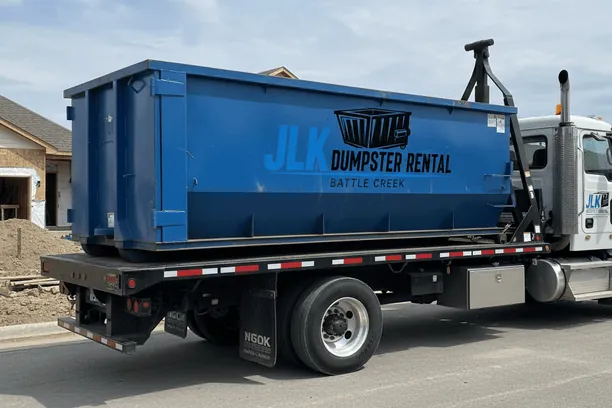
Roofing Dumpster Rental Battle Creek MI across Battle Creek and Calhoun County
A roofing square is a hundred square feet of finished roof. That is the unit every roofer works in and it is the unit we size containers in, because it converts directly into weight. Standard three-tab asphalt shingle runs somewhere in the region of two hundred and fifty pounds per square. Heavier architectural or laminated product runs closer to four hundred. Multiply by your square count. Then multiply again by the number of layers coming off, because a second layer is not a rounding error, it doubles the load.
That last part is where Battle Creek jobs go wrong. A great deal of the housing stock here has been re-roofed over the top at least once, and plenty of it twice, which was normal practice for decades. You do not find out until the first course comes up. If there is any doubt, pull a shingle at the eave before you book, or tell us it might be two and we will plan for a second pull rather than an overloaded box.
Why the container is smaller than you expect
The instinct is to order the biggest box and only think about it once. With shingles that is precisely wrong, and for two independent reasons.
The first is weight. Dense material reaches a legal payload long before it fills the volume, so a large container loaded with tear-off will be at its allowance while it still looks two-thirds empty. You have paid for cubic yards you are not permitted to use. The second is ergonomics, which crews feel more than owners do. A big roll-off has high side walls. Shovelling and barrowing tear-off over a high wall from ground level is slow, miserable work, and on a full-day strip it costs real hours. Low walls and a swing door beat capacity every time on a roof.
- Up to roughly twenty squares, single layer: a 15 yard is usually right
- Twenty to thirty squares single layer, or a two-layer tear-off: step up to a 20 yard
- Three layers, or a large cut-up roof with dormers and valleys: plan two pulls, not one bigger box
- Cedar shake, slate or clay tile: call first, the density is nothing like asphalt
- Metal roofing: separate it out, scrap value beats disposal every time
- Flat or low-slope with old built-up layers: heavier than it looks, describe it on the phone
If you want to compare the actual footprints and wall heights, they are laid out on the container sizes page. The 15 yard is the size most residential tear-offs in this town settle on.
Placement decides how fast the strip goes
A tear-off moves at the speed the crew can clear debris away from the base of the roof. That makes placement worth five minutes of thought rather than a shrug. We want the container as close to the eave the crew is stripping from as the approach allows, angled if the drop zone is off to one side, so that shingles land in or beside the box rather than sixty feet away across a lawn.
Older properties here often have a single-width drive running back to a detached garage. That can be ideal, since it puts the box beside the house rather than out front, but only if the drive is wide enough and firm enough for the truck. Boards go under the rails on every driveway placement as standard, which matters more than usual on roofing work because the load is dense and the contact pressure is high. Where there is no drive at all, the container goes on the street and that needs permission from the city or township, which rules out a same-day drop. Ask early.
Flashing, nails and the tidy-up
A tear-off produces more metal than people plan for: drip edge, step and counter flashing, valley metal, old vents, ridge, and sometimes an entire porch roof. Pull it into its own pile as you strip. It keeps the shingle load clean and metal has scrap value in Michigan that is worth collecting rather than burying.
The other tear-off constant is nails. Magnet-sweep the drive, the lawn and the strip beside the container at the end of every day rather than at the end of the job, because the homeowner's tyres will find what you miss. Tarps around the base of the box also cut the amount of granule and debris that ends up in the flower beds, which is the complaint that generates the most callbacks in this trade.
Booking around Michigan weather
Roofing season here is compressed at both ends. Late summer into autumn is the rush, as every crew in the county tries to get roofs watertight before the first hard freeze, and ice damming through February writes the following spring's work list. Book the container for the specific day the crew is booked, not the week. Pricing is flat-rate with a stated tonnage allowance, and if you tell us squares and layers we will quote it accurately on the first call. There is more on rental periods and swap timing on the FAQ page.
Which size suits the job
Most residential tear-offs land on a 15 yard: roughly twenty squares of single-layer asphalt, with low side walls that a crew can shovel over without a ramp. Step to a 20 yard for twenty to thirty squares, or for any two-layer strip, since the second layer effectively doubles the weight. Above that, take two pulls rather than one oversized container, because a 30 or 40 yard filled with shingle reaches a legal payload while it still looks empty and the wall height slows the crew down all day. Cedar, slate and tile are dense enough that the asphalt rules of thumb do not transfer, so call before ordering.
- Sized by squares and layers, so you are not paying for space you cannot fill
- Low-wall containers a crew can actually shovel into from the ground
- Set close to the eave and angled to the drop zone where access allows
- Boards under the rails, which matters most on dense tear-off loads
- Same-day drops on orders placed before noon during the autumn rush
- Honest advice on second layers before you order the wrong box
Sizes
Which container for roofing dumpster rental?
Every service runs in all four sizes. Match the material to the weight allowance and the rest takes care of itself.
| Size | Dimensions | Capacity | Weight included | Best for |
|---|---|---|---|---|
| 10 Yard Dumpster | 12 ft long × 8 ft wide × 3.5 ft high | about 3 pickup truck loads | 1–2 tons | Small bathroom remodels, single-room cleanouts, concrete and heavy debris, roofing up to about 15 squares. |
| 15 Yard Dumpster | 16 ft long × 8 ft wide × 4 ft high | about 4–5 pickup truck loads | 2–3 tons | Basement and attic cleanouts, kitchen remodels, medium roof tear-offs, small deck removals. |
| 20 Yard Dumpster | 22 ft long × 7.5 ft wide × 4.5 ft high | about 6 pickup truck loads | 3–4 tons | Whole-home decluttering, flooring and siding jobs, large tear-offs, drywall and mud phases. |
| 30 Yard Dumpster | 22 ft long × 8 ft wide × 6 ft high | about 9 pickup truck loads | 4–5 tons | Full-house renovations, new construction, estate clearances, commercial fit-outs and demolition. |
| 40 Yard Dumpster | 22 ft long × 8 ft wide × 8 ft high | about 12 pickup truck loads | 5–6 tons | Large commercial fit-outs, industrial clear-outs, major renovations and high-volume light debris. |
Talk to a real person
Need roofing dumpster rental in Battle Creek?
Call (269) 924-0171 and describe the job. You will get a flat price and a delivery time on the same call — most orders before noon go out the same day.
Mon–Sat 7:00am – 6:00pm · Sun by appointment
Answers
Roofing Dumpster Rental — your questions
How many squares fit in a 20 yard container?
As a working rule, roughly twenty-five to thirty squares of single-layer asphalt shingle, or about half that if you are pulling two layers. Architectural shingle is noticeably heavier than three-tab, so shade the estimate down if the roof carries thick laminated product. Tell us squares and layers on the phone and we will choose the box for you.
Why not just order the biggest dumpster for a roof?
Because shingles are dense. A large container will reach its weight allowance while still looking two-thirds empty, so you pay for volume you are not permitted to use. The side walls are also too high to shovel over comfortably from the ground, which costs a crew real hours on a full-day strip. Two pulls of the right size beat one of the wrong size.
How do I know if there are two layers up there?
Lift a shingle at the eave or look at the rake edge before you book. A great deal of Battle Creek housing stock was re-roofed over the top at least once, which was standard practice for decades, so it is common here. If you genuinely cannot tell, say so when you order and we will plan for the possibility of a second pull instead of an overweight container.
Can the container sit on the street for a roof job?
Often it has to, on older lots with no usable drive, but street placement needs permission from whichever municipality the address sits in. That takes lead time and rules out same-day delivery in most cases. Where there is a driveway, we will set the box as close to the eave as the approach allows, on boards, and angle it toward the drop zone.
What do I do with the old flashing and metal?
Keep it in its own pile as you strip. Drip edge, step and counter flashing, valley metal, vents, ridge and any old metal roofing all have scrap value, and separating them keeps the shingle load clean. It takes no extra time if you do it during the tear-off and it is a nuisance if you try to fish it out afterwards.
Service area
Roofing Dumpster Rental across southwest Michigan
We run roll-off dumpsters out of our 79 Grand Trunk Ave yard across Calhoun County and Kalamazoo County — from the older streets of Urbandale, Springfield and Post Addition out to Pennfield and Bedford, east on I-94 to Marshall and Albion, and west toward Galesburg, Portage and Kalamazoo. If your town is not on this list, call us anyway. We probably still get there.