
Weight, not volume
Concrete & Heavy Debris Dumpster Rental Battle Creek MI
Dense material inverts every rule of thumb about renting a container. Normally you run out of space first. With concrete, brick, block, asphalt and soil you run out of weight while the box still looks nearly empty, and the picture in your head of a full container is exactly the picture that gets a load refused at the gate. Small box, marked line, clean load.
- Licensed & insured
- Same-day delivery
- Flat-rate pricing
- Locally owned
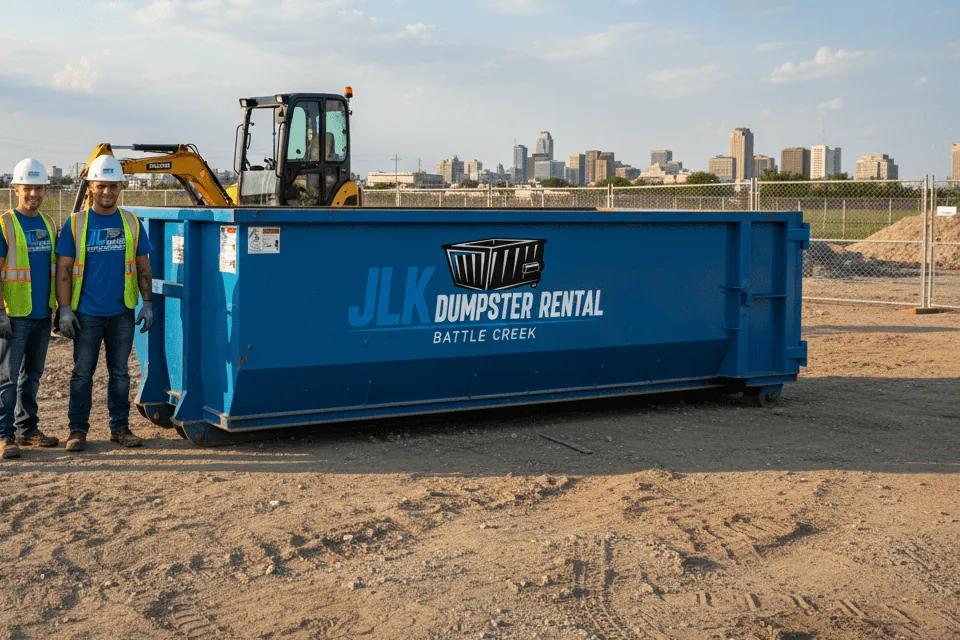
Concrete & Heavy Debris Dumpster Rental Battle Creek MI across Battle Creek and Calhoun County
A cubic yard of broken concrete weighs somewhere in the region of two tons. That single number explains everything else on this page. Ten cubic yards of it would be twenty tons of payload, which no roll-off truck on the road can lift onto its bed, let alone legally carry down a public street. The container is not the constraint. The truck, the axle limits and the road are the constraints, and the container is simply the tool that keeps you on the right side of them.
So heavy debris is a different product with different rules from every other service we run. You want the smallest box, not the biggest. You want low side walls so a wheelbarrow can be tipped over the rail without building a ramp. You want a marked fill line rather than a top rail. And you want the load kept clean of everything that is not masonry, for reasons that turn out to be financial as well as practical.
Why the 10 yard is the right container
The 10 yard exists for exactly this work. Short footprint, so it fits a narrow older driveway without occupying the whole apron. Low walls, so a barrow tips in at chest height rather than over your head. And a volume that reaches a legal payload before it runs out of room, which is the whole design intent. Ordering a large container for concrete is ordering a box you are not permitted to fill.
- Broken concrete and slab: roughly two tons per cubic yard, so plan on depth, not fullness
- Brick and block: a little lighter than solid concrete, same principle exactly
- Asphalt millings and pavement: heavy, and worth keeping clean for recycling
- Soil, sod and stone: wet soil is dramatically heavier than dry, and Michigan spring soil is wet
- Tile, mortar bed and old thinset: denser than people expect from a bathroom
- Sand, gravel and pea stone: fine in small quantities, call first for anything larger
Two clean 10 yard pulls almost always beat one oversized container that arrives overweight and has to be partially unloaded. If your project also produces plaster, timber and general strip-out debris, that wants a separate container alongside it, described on the demolition debris page.
The fill line is not a suggestion
On heavy loads the driver will point out a fill line before he leaves. If that line is eighteen inches up the wall, eighteen inches is the top of your load, even though there is obviously room above it. A container loaded past a safe payload cannot be winched up the bed without risking the cable and the rails, it cannot legally travel, and the practical outcome is that somebody stands in your driveway pulling material back out by hand.
Load it evenly across the floor rather than heaping everything by the door end. Weight concentrated at one end sits badly on the bed and makes the pull genuinely dangerous. And resist the very natural urge to top a masonry load off with a few bags of general rubbish just because there is space above the line, since that one decision is what turns a clean load into an expensive one.
Clean masonry is the cheapest heavy load there is
Concrete, brick and block are recovered and crushed into aggregate rather than simply buried, and processors want clean material. A container holding nothing but broken masonry has a straightforward destination. The same container plus a few sacks of trash, a length of treated timber, some plastic sheeting and an old sink becomes a contaminated load that has to be picked apart before anything can be done with it, and that cost lands somewhere.
Rebar is generally fine within reason, since reinforcing steel is recovered during crushing. Wood forms, foam insulation, plastic sheeting, wire mesh in quantity and general household rubbish are not. Michigan's solid waste and recycling programmes are administered by EGLE at state level, with the practical arrangements varying by county and municipality, so if you are unsure how a particular material is handled locally, ask us or ask your county.
Driveways, and the season
Heavy loads concentrate more weight onto four small contact points than any other job we do, and a great many driveways in this town have already been opened up by freeze-thaw cycling and years of road salt. Boards go under the rails as standard, and on a drive with visible cracking or a soft patch we would rather set the box at the kerb edge, or on the street with the municipality's permission, than take the risk. Point out the weak spots before the driver backs in.
One seasonal note. During the spring thaw window, roughly March through May, county and local road authorities post seasonal weight restrictions while frost leaves the ground, and heavy loads are the first thing those restrictions bite on. If your concrete job falls in that window, call (269) 924-0171 early and we will tell you what is actually possible on your route rather than promising and rescheduling.
Which size suits the job
For concrete, brick, block, asphalt, tile, soil and stone, the 10 yard is the container you want, and usually the only one we will send. It has the short footprint that fits an older Battle Creek driveway, low walls for tipping a barrow, and it reaches a legal payload well before it runs out of cubic yards. A 15 yard is occasionally used for lighter mixed rubble with a low fill line marked on it. Anything larger is the wrong tool: a 20, 30 or 40 yard filled with masonry would be far beyond what a roll-off truck can lift or legally carry. Take two clean pulls rather than one overweight box.
- Small dedicated containers, because the truck sets the limit, not the box
- Marked fill line explained on delivery so nothing arrives overweight
- Low walls a loaded wheelbarrow can be tipped over without a ramp
- Clean masonry kept clean, which is what makes a heavy load affordable
- Boards under the rails, and honest advice when a driveway should not take it
- Spring weight restrictions flagged before they derail your schedule
Sizes
Which container for concrete & heavy debris?
Every service runs in all four sizes. Match the material to the weight allowance and the rest takes care of itself.
| Size | Dimensions | Capacity | Weight included | Best for |
|---|---|---|---|---|
| 10 Yard Dumpster | 12 ft long × 8 ft wide × 3.5 ft high | about 3 pickup truck loads | 1–2 tons | Small bathroom remodels, single-room cleanouts, concrete and heavy debris, roofing up to about 15 squares. |
| 15 Yard Dumpster | 16 ft long × 8 ft wide × 4 ft high | about 4–5 pickup truck loads | 2–3 tons | Basement and attic cleanouts, kitchen remodels, medium roof tear-offs, small deck removals. |
| 20 Yard Dumpster | 22 ft long × 7.5 ft wide × 4.5 ft high | about 6 pickup truck loads | 3–4 tons | Whole-home decluttering, flooring and siding jobs, large tear-offs, drywall and mud phases. |
| 30 Yard Dumpster | 22 ft long × 8 ft wide × 6 ft high | about 9 pickup truck loads | 4–5 tons | Full-house renovations, new construction, estate clearances, commercial fit-outs and demolition. |
| 40 Yard Dumpster | 22 ft long × 8 ft wide × 8 ft high | about 12 pickup truck loads | 5–6 tons | Large commercial fit-outs, industrial clear-outs, major renovations and high-volume light debris. |
Talk to a real person
Need concrete & heavy debris in Battle Creek?
Call (269) 924-0171 and describe the job. You will get a flat price and a delivery time on the same call — most orders before noon go out the same day.
Mon–Sat 7:00am – 6:00pm · Sun by appointment
Answers
Concrete & Heavy Debris — your questions
How much concrete actually fits in a 10 yard container?
Far less than the yardage implies. Broken concrete runs around two tons per cubic yard, so a legal payload is reached with roughly a foot or two of material spread across the floor. The driver marks a fill line and that line is the top of the load. Two clean pulls beat one overloaded container that cannot legally leave your property.
Why can I not use a bigger container for concrete?
Because the truck and the road set the limit, not the box. A 30 or 40 yard filled with masonry would weigh far more than any roll-off truck can safely winch onto its bed or legally carry on a public street. The 10 yard is purpose-built for dense material: low walls, short footprint, and a volume that reaches payload before it runs out of room.
Can I mix concrete with other debris?
Please do not. Masonry is crushed and recovered as aggregate rather than simply buried, and that only works with clean material. A container of nothing but concrete and brick is the cheapest heavy load you can send. Add trash bags, treated timber, plastic sheeting or foam and it becomes a contaminated load that has to be sorted before anything can be done with it.
Is rebar in the concrete a problem?
Within reason, no. Reinforcing steel is recovered during the crushing process, so ordinary rebar left in broken slab or footing material is normal and expected. What causes trouble is everything else: wood forms, plastic sheeting, foam board, insulation and general rubbish. If you are pulling out something unusual, describe it on the phone before the container arrives.
Will a heavy load damage my driveway?
It is the highest-risk load type we handle, which is why boards go under the rails as standard. The real variable is the condition of the surface. Older asphalt here takes a beating from freeze-thaw and road salt and often has cracking the owner stopped noticing years ago. Point out the weak spots and we will set the box at the kerb or on the street instead.
Service area
Concrete & Heavy Debris across southwest Michigan
We run roll-off dumpsters out of our 79 Grand Trunk Ave yard across Calhoun County and Kalamazoo County — from the older streets of Urbandale, Springfield and Post Addition out to Pennfield and Bedford, east on I-94 to Marshall and Albion, and west toward Galesburg, Portage and Kalamazoo. If your town is not on this list, call us anyway. We probably still get there.