
For jobsites
Construction Dumpster Rental Battle Creek MI
Sizing one container for a whole build is the most expensive habit on a jobsite. Demolition, framing, roofing and finish all produce different material at wildly different densities, and no single box is right for all four. We size by phase, swap fast enough to keep a crew working, and tell you before delivery which parts of your debris are going to hit the tonnage allowance early.
- Licensed & insured
- Same-day delivery
- Flat-rate pricing
- Locally owned
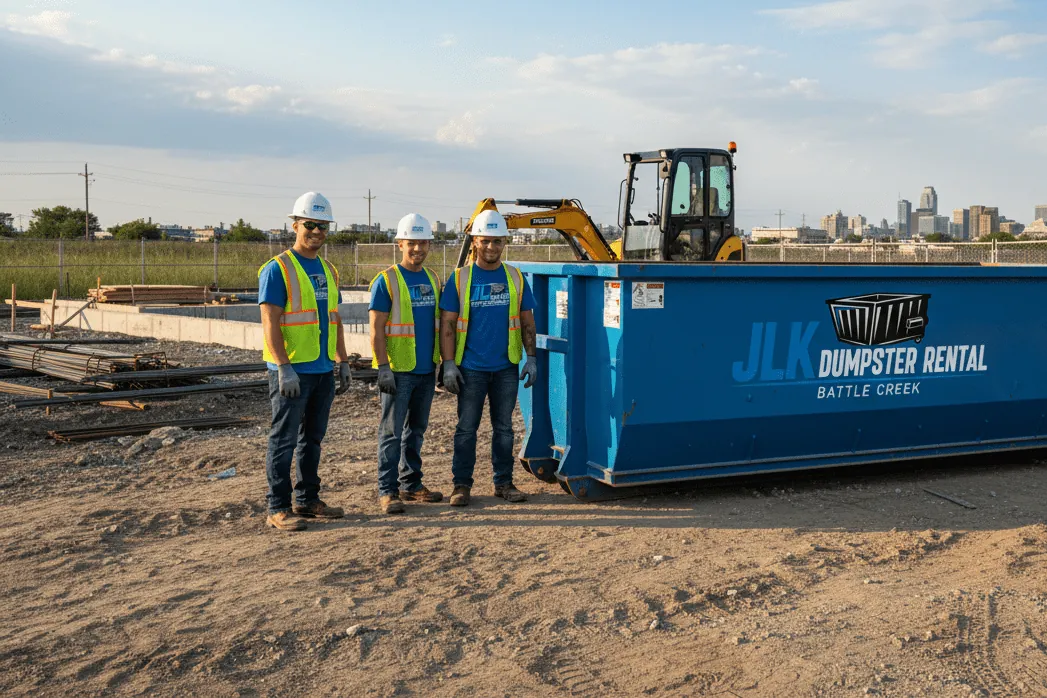
Construction Dumpster Rental Battle Creek MI across Battle Creek and Calhoun County
Contractors rarely call us with a sizing question. They call with a scheduling question, because the container is only ever a problem when it is full and the crew is standing around. So the useful way to think about jobsite containers is as a flow rate rather than a capacity: how fast does this phase generate debris, and how quickly can we clear it. Everything else follows from that.
Size by phase, not by project
A gut and strip-out in an older Battle Creek building is dense work. Plaster over wood lath, old dimensional lumber, tile, mortar bed. That material reaches a tonnage allowance while the container still looks like it has room, which is why the right move is a mid-size box filled to a line rather than a large one you will never legally fill. Framing and sheathing is the opposite: offcuts, packaging, housewrap and foam are almost pure volume, and that is where a 30 or 40 yard earns its money.
Roofing sits in its own category entirely and wants a dedicated container; there is a full explanation on the roofing page. Finish and punch-list debris is the phase people forget to budget for at all: cardboard, cut-offs, packaging, buckets, and the general accumulation of a handover week. It is mid-size, it is mixed, and if you have not planned a container for it the crew ends up using the pickup bed.
The practical version
- Demolition and strip-out: dense, heavy, fill to a marked line rather than to the top rail
- Excavation spoil and masonry: separate container every time, never mixed with general debris
- Framing and sheathing: bulky, light, this is where the big boxes belong
- Mechanical rough-in: metal in quantity, and metal is usually worth pulling out for scrap
- Finish and punch list: mixed, mid-size, and the phase most often left unplanned
- Site clean and handover: one final swap timed against the certificate of occupancy inspection
Before anyone breaks ground
If your scope involves digging, whether that is footings, a new service run, a stoop, or simply setting a container on ground that is going to be excavated later, the utility locate comes first. Michigan law requires notification before excavation, and the free statewide service is MISS DIG 811. Locate tickets take days, not hours, and they are the single most common reason a jobsite schedule slips before it has started. Plan the container delivery around the same calendar.
Swap rhythm on a lot with nowhere to stage
Infill lots and older residential streets here rarely give you room for three containers at once. That usually means one placement and a fast swap rather than a staging area. The rule we push hardest is to call the swap at about three-quarters full instead of waiting until it heaps, because an overloaded container cannot legally leave the site and the crew loses a half-day waiting for a second visit.
Same-day swaps on orders placed before noon are the normal case, and that is the number the routes are built around, because a stalled crew costs far more than a haul does. There is more detail on how that works and where it breaks down on the same-day page.
What slows a Michigan jobsite down
Two seasonal constraints are worth building into a programme. The first is the spring thaw window, roughly March through May, when the county road commission and local road authorities post seasonal weight restrictions while frost leaves the ground. A loaded roll-off truck is subject to those like any other heavy vehicle, and on rural or lightly built routes in Calhoun County it genuinely limits what can be hauled and when. The second is winter itself: a container half full of snow and ice weighs a great deal more than the debris in it, and covering or tarping between visits is worth the trouble.
The third constraint is not seasonal at all. In a building predating 1980, assume the possibility of asbestos in pipe lagging, boiler jacketing, floor tile and mastic, and certain joint compounds and siding products. Assume lead paint in anything pre-1978. Neither goes in one of our containers, both follow their own licensed routes, and both need to be identified by a qualified inspector before demolition begins rather than discovered during it. That sequencing is described further on the demolition debris page.
Keeping the load clean
Mixing streams costs money at both ends. Clean concrete, brick and block belong in their own dedicated heavy container, described on the concrete and heavy debris page, because a clean masonry load is the cheapest heavy load there is and a contaminated one is not. Scrap metal is worth staging separately. Clean untreated wood is worth staging separately where the site has room. It takes a toolbox talk, a bit of tape on the ground and about ten minutes to organise, and it is the biggest single lever a site supervisor has over the disposal line on a job.
Everything we run is flat-rate with the tonnage allowance stated before the container leaves the yard, so a foreman can budget the disposal line properly rather than guessing. Call (269) 924-0171 with the phase and the address and we will tell you the size and the delivery window in the same conversation.
Which size suits the job
Demolition and strip-out phases suit a 15 or 20 yard filled to a line, because plaster, lath, tile and old dimensional lumber reach the allowance long before the box looks full. Framing, sheathing and general rough carpentry want a 30 yard, and a large commercial build-out producing packaging and offcuts in bulk justifies a 40. Keep masonry and excavation spoil in a dedicated 10 yard rather than adding it to a general container. On a site with one placement spot, the right answer is usually one mid-size box with a disciplined swap rhythm instead of a large box you cannot legally fill.
- Containers sized by build phase instead of one guess for the whole job
- Same-day swaps on orders placed before noon keep crews moving
- Flat rate with a stated tonnage allowance so the disposal line is budgetable
- Advice on staging metal, clean wood and masonry separately from day one
- We flag spring weight restrictions before they hit your haul schedule
- Straight sizing for infill lots that only allow one placement spot
Sizes
Which container for construction dumpster rental?
Every service runs in all four sizes. Match the material to the weight allowance and the rest takes care of itself.
| Size | Dimensions | Capacity | Weight included | Best for |
|---|---|---|---|---|
| 10 Yard Dumpster | 12 ft long × 8 ft wide × 3.5 ft high | about 3 pickup truck loads | 1–2 tons | Small bathroom remodels, single-room cleanouts, concrete and heavy debris, roofing up to about 15 squares. |
| 15 Yard Dumpster | 16 ft long × 8 ft wide × 4 ft high | about 4–5 pickup truck loads | 2–3 tons | Basement and attic cleanouts, kitchen remodels, medium roof tear-offs, small deck removals. |
| 20 Yard Dumpster | 22 ft long × 7.5 ft wide × 4.5 ft high | about 6 pickup truck loads | 3–4 tons | Whole-home decluttering, flooring and siding jobs, large tear-offs, drywall and mud phases. |
| 30 Yard Dumpster | 22 ft long × 8 ft wide × 6 ft high | about 9 pickup truck loads | 4–5 tons | Full-house renovations, new construction, estate clearances, commercial fit-outs and demolition. |
| 40 Yard Dumpster | 22 ft long × 8 ft wide × 8 ft high | about 12 pickup truck loads | 5–6 tons | Large commercial fit-outs, industrial clear-outs, major renovations and high-volume light debris. |
Talk to a real person
Need construction dumpster rental in Battle Creek?
Call (269) 924-0171 and describe the job. You will get a flat price and a delivery time on the same call — most orders before noon go out the same day.
Mon–Sat 7:00am – 6:00pm · Sun by appointment
Answers
Construction Dumpster Rental — your questions
What size should I start a remodel with?
Start with the phase rather than the project. A gut and strip-out wants a 15 or 20 yard filled to a line, because plaster and lath in an older Battle Creek building hit the weight allowance well before the container looks full. Framing and sheathing want a 30, since offcuts and packaging are volume with almost no weight. Call at each phase change and we will resize it.
How fast can you swap a full container?
Most swaps called in before noon happen the same day, and the routes are built around that because a stopped crew is expensive. Call it at roughly three-quarters full rather than waiting for it to heap, since an overloaded container cannot legally leave the site and you lose the slot. Weather and street placements are the two things that stretch it.
Do spring weight restrictions really affect deliveries?
Yes, for a few weeks. Seasonal weight limits posted by county and local road authorities during the thaw, roughly March through May, apply to loaded roll-off trucks. In-town addresses are mostly unaffected. Sites on rural or lightly built roads in Calhoun County can see real constraints on what can be hauled and when, so tell us the address early and we will plan around it.
Can you work on a lot with only one placement spot?
That describes most infill and older residential lots here and it is routine work. The answer is one well-chosen container plus a disciplined swap rhythm rather than staging several boxes you have no room for. Pick a spot with about sixty feet of straight approach and twenty-three feet of overhead clearance and keep it free of parked vehicles and stacked material.
Do I need to call for utility locates before you deliver?
You need locates before you excavate, which is a separate requirement from the container. Michigan law requires notification before digging and MISS DIG 811 handles it free of charge, but tickets take days rather than hours. If your container is going on ground you later intend to dig, or over a service run, factor the locate into the same schedule as the delivery.
Service area
Construction Dumpster Rental across southwest Michigan
We run roll-off dumpsters out of our 79 Grand Trunk Ave yard across Calhoun County and Kalamazoo County — from the older streets of Urbandale, Springfield and Post Addition out to Pennfield and Bedford, east on I-94 to Marshall and Albion, and west toward Galesburg, Portage and Kalamazoo. If your town is not on this list, call us anyway. We probably still get there.