

Protecting Your Driveway During a Dumpster Rental
The risk is concentrated into two short windows, not the whole rental. Here is when driveway damage actually happens, how each surface fails, and where the boards go.
ReadBattle Creek, MI guide
Shingles are dense enough that a roofing dumpster is almost always smaller than homeowners expect. Here is how to estimate squares, account for layers, and pick the right roll-off for a Battle Creek tear-off.
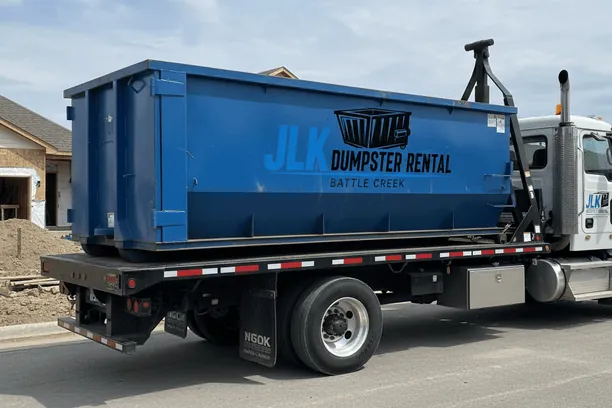
A shingle tear-off is one of the few jobs where the dumpster you want and the dumpster you need are almost never the same box. Homeowners around Battle Creek call JLK Dumpster Rental looking at a roof, doing the mental math on how big that pile is going to look in the driveway, and asking for a 30 or a 40 yard. Then we ask two questions — roughly how many squares, and how many layers are coming off — and the answer usually lands on something smaller. Not because we are trying to sell you less, but because asphalt shingles are one of the densest things we haul.
Roofing debris is heavy out of all proportion to its bulk. A container that looks half empty can already be over what a truck is legally allowed to carry down Michigan roads, and that is a problem you want solved before the tear-off starts, not after. This guide walks through how roofers measure a job, what a square of shingles typically weighs, why a second or third layer changes everything, and what container we would put in your driveway for jobs between 15 and 30 squares. If you would rather skip to the answer, call (269) 924-0171 with your roof dimensions and layer count and we will size it with you.
Roofers do not talk in square feet. They talk in squares, and one square equals 100 square feet of finished roof surface. A modest ranch might be 15 squares. A two-story colonial with a garage could run 30 or more. Getting this number roughly right is the single most useful thing you can do before you order a container.
If you have no paperwork from a roofer, you can get close on your own. Measure the outside footprint of the house — length times width — and add any attached garage or porch that is under the same roofline. That gives you a flat footprint in square feet. Then multiply by a pitch factor, because a sloped roof has more surface than the ground it covers:
Divide by 100 and you have your squares. Add a little for dormers, hips and valleys, which all create waste. A 1,400 square foot footprint on a 6/12 pitch works out around 15.5 squares — call it 16. Older Battle Creek neighbourhoods are full of steep 8/12 and 9/12 roofs, so do not skip the pitch factor there.
This is where the sizing decision is really made. Shingle weight varies by manufacturer, product line and age, so treat everything below as a typical industry range rather than a promise about your specific roof:
Then add the rest of the tear-off. Felt or synthetic underlayment, ice-and-water shield, thousands of nails, drip edge, step and valley flashing, pipe boots, ridge vent, and any rotten decking you replace all go in the same box. Budget another 10 to 15 percent on top of the shingle weight, and more if you are sheeting over bad plank decking.
Michigan code has long allowed a limited number of roof coverings, and plenty of homes in Calhoun County have had a second layer laid over the original rather than a full tear-off. On older Battle Creek housing stock, two layers is common and three is not unheard of. The arithmetic is blunt: two layers is roughly double the weight, three is roughly triple. A 20 square roof with two layers of architectural shingle can approach the tonnage of a small demolition job.
Do not guess. Lift a shingle at a rake edge and count the courses, or read the layer count off your roofer's estimate. It changes the container recommendation more than any other single factor.
Every roll-off has two limits: the volume of the box and the weight the truck can legally haul. On almost every other job — a garage cleanout, a remodel, brush — you run out of space long before you run out of weight. Roofing is the exact opposite. Shingles are dense, they stack flat, and they settle. You will hit the weight ceiling with the box a third to half full.
Put it this way: a 40 yard roll-off filled to the rails with shingles would be carrying something on the order of twenty tons. That truck is not leaving your driveway, and it certainly is not going down Capital Avenue. Federal and state axle-weight rules cap what any single haul can carry, and Michigan's seasonal frost laws tighten those limits further during the spring thaw, when road restrictions come into force across the state. That is why we put shingles in 15, 20 and 30 yard boxes and rarely anything larger, no matter how big the roof is. The larger boxes are there for bulk; roofing is a weight game.
The table below uses the ranges above plus an allowance for underlayment and fasteners. Weights are approximate and hedged deliberately — a heavy premium architectural shingle can sit above the top of the range, and a sun-baked thin three-tab below the bottom of it.
| Squares | Layers & type | Approximate weight | Suggested container |
|---|---|---|---|
| 15 | 1 layer, three-tab | ~1.5–2.0 tons | 10 or 15 yard |
| 15 | 1 layer, architectural | ~2.7–3.5 tons | 15 or 20 yard |
| 15 | 2 layers, mixed | ~4.0–5.5 tons | 20 or 30 yard |
| 20 | 1 layer, three-tab | ~2.0–2.7 tons | 15 yard |
| 20 | 1 layer, architectural | ~3.5–4.7 tons | 20 or 30 yard |
| 20 | 2 layers, mixed | ~5.5–7.5 tons | 30 yard, likely a swap |
| 25 | 1 layer, three-tab | ~2.6–3.4 tons | 20 yard |
| 25 | 1 layer, architectural | ~4.4–5.9 tons | 30 yard |
| 25 | 2 layers, mixed | ~7.0–9.5 tons | 30 yard plus a second haul |
| 30 | 1 layer, three-tab | ~3.1–4.1 tons | 20 or 30 yard |
| 30 | 1 layer, architectural | ~5.3–7.0 tons | 30 yard, plan for a swap |
| 30 | 2 layers, mixed | ~8.5–11.5 tons | 30 yard, two hauls |
Notice how often the answer involves a second pull rather than a bigger box. On a heavy tear-off it is normal to fill a 30 yard, have us take it, and drop an empty one back the same day so the crew never stops. Our same-day service exists largely because of roofing crews. If you are weighing a swap against a single larger container, our general sizing guide covers the trade-off in more detail.
Where the container sits changes how long the tear-off takes. Shingles thrown from the roof into a box parked tight against the eave land in the box. Shingles carried down a ladder and wheelbarrowed across the lawn cost hours of labour and usually damage the grass. Tell us which slope you are stripping first and we will set the container on that side, back end toward the house, with the door end clear so the crew can walk debris in if they need to.
Leave us a straight approach of about 60 feet and roughly 10 to 12 feet of width, plus overhead clearance — the hoist arm goes up around 22 feet, so mind the service drop and any low limbs. Call and describe the driveway if you are unsure.
A loaded roofing container is one of the heaviest things that will ever sit on your driveway, and it lands there with force. Ask for plywood or planks under the rails — two-by-tens or sheets of OSB under the wheels and rear rollers spread the load and keep steel off asphalt. Battle Creek summers soften blacktop enough that an unprotected drop can leave permanent impressions. Sweep the drop zone with a magnet afterwards too; a tear-off sheds an astonishing quantity of nails. There is more on this in our guide to protecting your driveway during a rental.
Rain is the sizing variable nobody plans for. Asphalt shingles and felt soak up water, and a load left open through an overnight thunderstorm can gain enough weight to push a borderline container over. If storms are forecast mid-project, tarp the box or get the loaded section hauled first.
Winter drives a lot of our roofing work. Ice dams form when heat escapes into the attic, melts snow at the ridge, and the runoff refreezes at the cold eave. The backed-up water works under the shingles and into the sheathing. Those replacements often come with rotten decking and saturated insulation in the load, both of which add weight beyond the shingle estimate. Add a margin when the tear-off is ice-dam driven.
Asphalt shingles, felt, ice-and-water shield, nails, flashing and decking can all go in the same roofing container. What cannot: propane tanks, paint, solvents, and household hazardous waste of any kind. Michigan also bans yard waste from landfill disposal, so if you are trimming limbs for roof access, keep that pile separate — see our yard waste service.
Two age-related cautions. Homes built before 1980 may have asbestos-containing roofing products, particularly built-up flat roofs, transite panels and some older mastics and felts; the EPA's asbestos resources explain when testing and licensed abatement are required, and suspect material must never go in a standard roll-off. Homes built before 1978 may have lead paint on fascia, soffit and trim, which matters if the job includes scraping or replacing those. For state-level waste and disposal rules, Michigan EGLE is the authority.
You do not need to work any of this out alone. Give us the approximate footprint, the pitch, the shingle type and the number of layers and we will match a container to it — and tell you honestly if the job needs two hauls instead of one. See our roofing dumpster service for what we handle, or get in touch and we will schedule the drop for the morning your crew starts. Call (269) 924-0171.
Talk to a real person
Call and describe the job. Flat price, stated tonnage, and a delivery time on the same call.
Mon–Sat 7:00am – 6:00pm · Sun by appointment
From this guide
For most Battle Creek homes, a 15 or 20 yard roll-off is the right call for a single-layer tear-off up to about 25 squares, and a 30 yard for larger roofs or two layers. Shingles are dense enough that you hit the weight limit long before the box is full, so the container is usually smaller than homeowners expect. Tell us squares and layers and we will size it.
Weights vary by manufacturer and product line, so treat these as typical industry ranges. Three-tab shingles are commonly cited at roughly 200 to 250 pounds per square, and architectural or dimensional shingles at roughly 350 to 450 pounds per square. Add another 10 to 15 percent for underlayment, ice-and-water shield, nails, flashing and any decking you replace during the tear-off.
Because it would never legally leave your driveway. A 40 yard box filled with shingles would weigh roughly twenty tons, far beyond what a truck can carry under federal and Michigan axle-weight rules, and spring frost laws tighten those limits further. You would pay for volume you cannot use. Two hauls with a 30 yard is the normal answer on a heavy tear-off.
Significantly. Two layers is roughly double the weight and three is roughly triple, and layered roofs are common on older Battle Creek housing. A 20 square roof that fits comfortably in a 15 yard as a single layer can need a 30 yard plus a second haul with two layers. Check the layer count at a rake edge before ordering, or read it off your roofer's estimate.
As close to the eave you are stripping first as the driveway allows, so shingles can be thrown straight into the box instead of being carried down a ladder. We need about 60 feet of straight approach, 10 to 12 feet of width and roughly 22 feet of overhead clearance. Ask for plywood under the rails to protect asphalt, and sweep for nails afterwards.
Keep reading
The risk is concentrated into two short windows, not the whole rental. Here is when driveway damage actually happens, how each surface fails, and where the boards go.
ReadA practical room-by-room, day-by-day plan for clearing a Battle Creek house. Scope honestly, sort into four piles, sequence the rooms so the garage comes last, size the container against what is actually leaving, and load it so you get the volume you paid for.
ReadCardboard, scrap metal, tyres, paint, propane, brush and construction debris all take different roads out of a Battle Creek house. Here is a practical, material-by-material guide to which items belong in a roll-off, which go curbside, which pay you back, and where to confirm current Calhoun County arrangements.
Read